Forest protection
Protect forest and wildlife.
To save Borneo and Sumatra’s wildlife, Kalaweit works with the local populations. to ensure the long term protection of these areas, with no limit in time.
Forest management is provided by ANUA (Aksi Nyata Untuk Alam), while Borneo Flying Club is responsible for forest monitoring. These two structures led by Chanee and his son Andrew are closely linked to Kalaweit and act for the same purpose.
Concrete action ensures success
Close collaboration with the villagers and the authorities allows us to secure more and more lands.
We make sure that the forests belong to the local communities. Regular meetings are organized with the mayor, the village chief and the families to set up the protection of the area and organize the follow-up
The villagers still retain access to the land for their traditional activities (fruit picking, the collection of rattan and rubber), but they cannot cut down trees or hunt. The areas protected by the association are passed back to local communities
Boundary signs are placed every 20/30 meters along the periphery of the protected area. Guard posts are placed at strategic points such as entrances, water sources or in the most elevated areas.
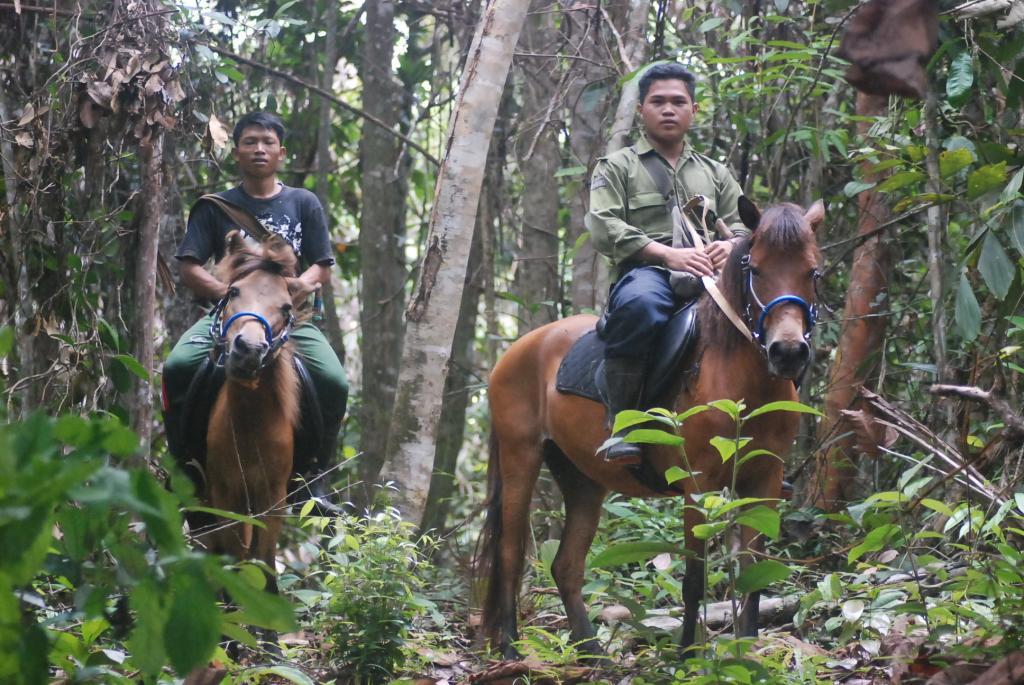
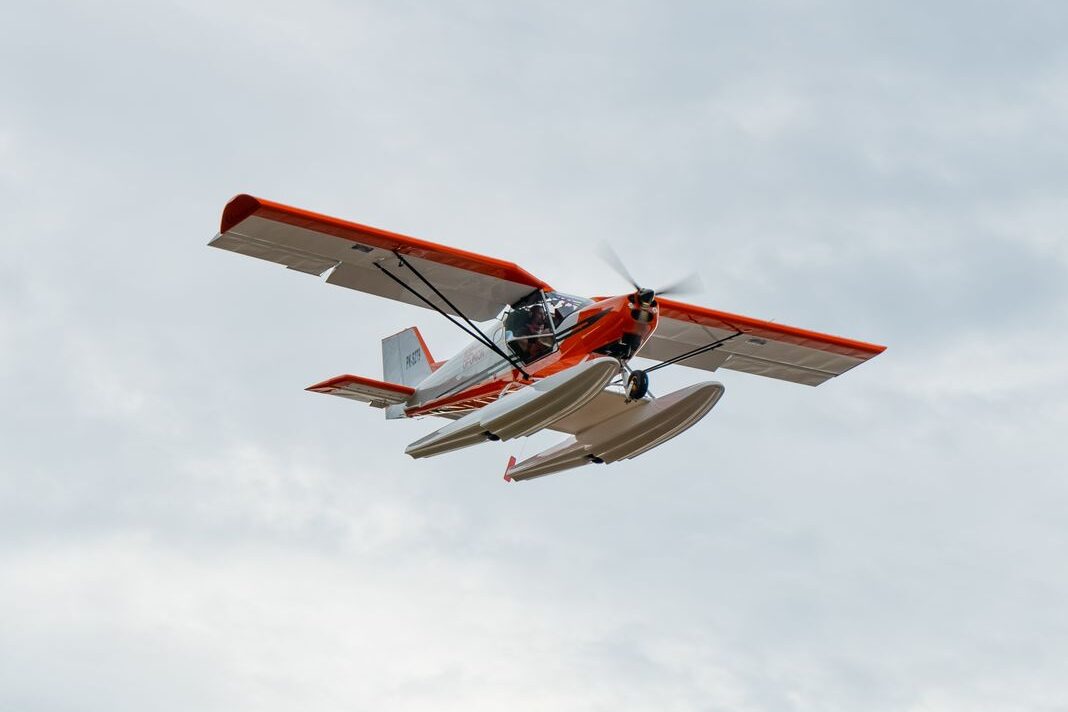
The surveillance of the forests is ensured by daily patrols. They are ensured by our forest rangers, hired from villages bordering the area. These job creations strengthen our ties with the villagers. Patrols, both equestrian and aerial (drone, seaplane) allow us to detect any suspicious activity.
To date, no illegal activity has been observed in those areas. This proves the effectiveness of our monitoring program, but above all testifies to our good relationship with the villagers and their support.
Viewing videos from camera traps placed in these areas, allows us to have a better understanding of the multitude of species present. It also allows us to observe their behaviour, their movements and interaction with other species.
We do not release gibbons into those forests. No additional pair of gibbons could find enough territory for their needs due to the lack of space. Natural habitat is shrinking drastically from year to year, yet the gibbons are territorial and cannot share their territory with other pairs. This is necessary to protect the populations of wild animals that are still free.
Protecting forests is an emergency in regions of the world ravaged by deforestation. Our approach is concrete, fast and effective.
The size of these protected areas increase regularly according to the amount of support we receive. Your help is essential to secure more lands and more animals. Each donor for Dulan or for our other forest reserves receives a symbolic document with their name, the amount of the donation and the area in square meters of lands thus secured.
Borneo Island
Central Kalimantan region, Barito Utara District
The Dulan Forest and the Great Dulan
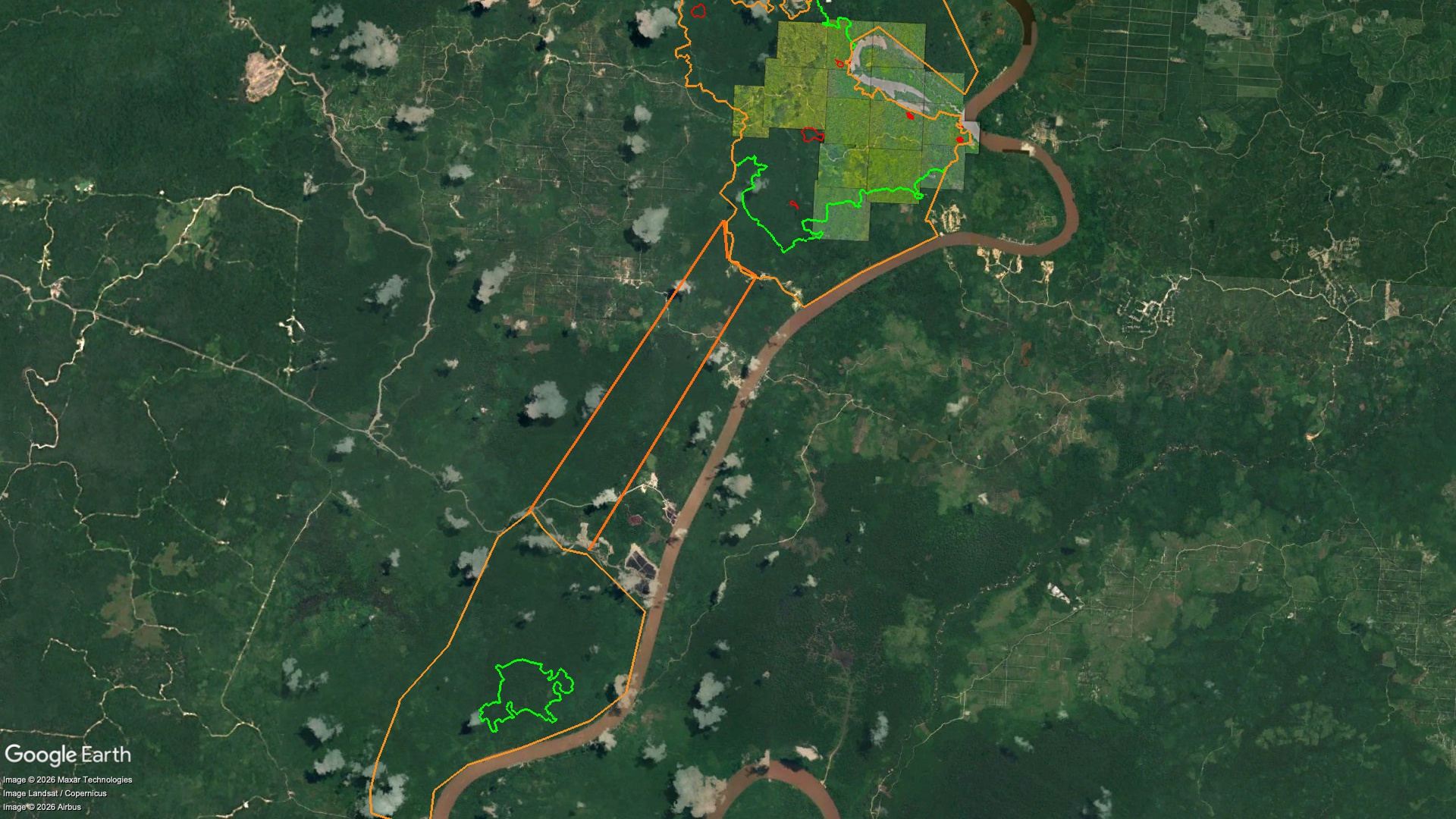
The Dulan Reserve currently spans three villages – Butong, Bintang Ninggi 2, and Buntok Baru – surrounded to the west and north by industrial oil palm plantations and mining concessions. This 2 227 hectare forest was saved from imminent deforestation in 2019, with the hectares secured by compensating local landowners to prevent companies from taking over. It was then established as a community-protected forest, and is co-managed by Kalaweit and ANUA and the local communities.
Daily patrols – on the ground and aerial by seaplane -protect the area and prevent incursions by employes of surrounding concessions. This constant vigilance helps preserve the integrity of one of the last fragments of lowland forest in this part of Kalimantan; the only protected area with orangutans in the Barito Utara district.

There are between 60 and 100 orangutans, 250 to 300 white-bearded gibbons, long-tailed and pig-tailed macacques, proboscis monkeys, tarsiers, langurs, slow lorises, Malayan sun bears, clouded leopards, wild cats, sambar deer, civets, hornbills, eagles, etc.
The forest is a mosaic of mature secondary forests and swampy areas, with imposing Dipterocarps (very tall trees), forest palms, rattans, and wild fruit trees crucial for primates and other wildlife.
A potential extension of approximately 400 hectares is possible to the south. To the north, the reserve borders Lake Butong and adjoins a community-protected forest managed by the village of Butong, preserved in the form of a traditional “communal garden” of nearly 500 hectares.
In total, the broader Dulan landscape with the current reserve, the potential southern extension, and the traditional communal forest covers nearly 3,000 hectares.
The Great Dulan (2 471.3 hectares) aims to replicate and expand this model by creating new reserves further south, in the villages of Kamawen, Paring Lahung, and Ruji, and connecting them northward to the existing Dulan reserve. In September 2025, a historic agreement was signed with the village of Ruji, and the first land transaction was made in October 2025. Today 244.3 hectares have already been saved.
The urgency is glaring: these forests, also surrounded by oil palm plantations and coal mining concessions, risk disappearing within 2 to 5 years if they are not secured in time.
By protecting this ecological corridor, we could save between 110 and 150 orangutans (lowest estimate), 5,000 to 7,000 hectares of forest, including 4,000 hectares of very high-quality secondary forest, rich in biodiversity and still relatively intact, and the cultural identity and traditional livelihoods of six villages (approximately 6,171 people) whose lives remain deeply connected to the forest.
This project is not just about land protection: it represents the last chance to preserve a vast block of lowland tropical rainforest – an irreplaceable ecosystem essential to the survival of great apes and hundreds of forest species.
The Dulan reserve and its expansion plans have the support of local authorities in the Barito Utara district, as well as the current Indonesian Minister of Forestry.
Pararawen

It borders our Pararawen camp, and covers 306,5 hectares. It is a secondary forest, located 40 meters above sea level. Some traditional rubber plantations are found there.
Several groups of more than fifty individuals of proboscis monkeys live there. It is an endangered species of monkey endemic to Borneo. 30% of its’ territory is located within this area. Our objective is to save the remaining 70% in order to secure them for the long term. This will allow these monkeys that have become rare as well as other species (binturong, macaques, gibbons, civets etc.) to have place to live.
This protected area consists of 2 sections:
- One part protected with the help of Brigitte Bardot Foundation (in blue) that helped to protect more than 80 hectares of forest ;
- Another part protected with the support of Kalaweit’s friends (in yellow).
These two areas continue to grow from year to year.
The Pararawen location
It is located opposite to the Pararawen camp, on the opposite side of the Barito river, which borders the Kalaweit camp, and covers 5,800 hectares. Half of the area is constituted of primary forest. A large population of wild gibbons has been observed there. We provide aerial surveillance for it.
This area has the status of sanctuary or “Cagar Alam” in Indonesian. It is assigned by the K.L.H.K. (Ministry of Environment and Forestry). It has extensions in the Indonesian provinces named K.S.D.A. (Konservasi Sumber Daya Alam). Kalaweit and the K.L.H.K. of Jakarta are therefore partners in the management of the Pararawen aera via the K.S.D.A. Together they collaborate by establishing an annual work plan.
Sumatra Island
Sumatra Barat region, Solok District
Supayang
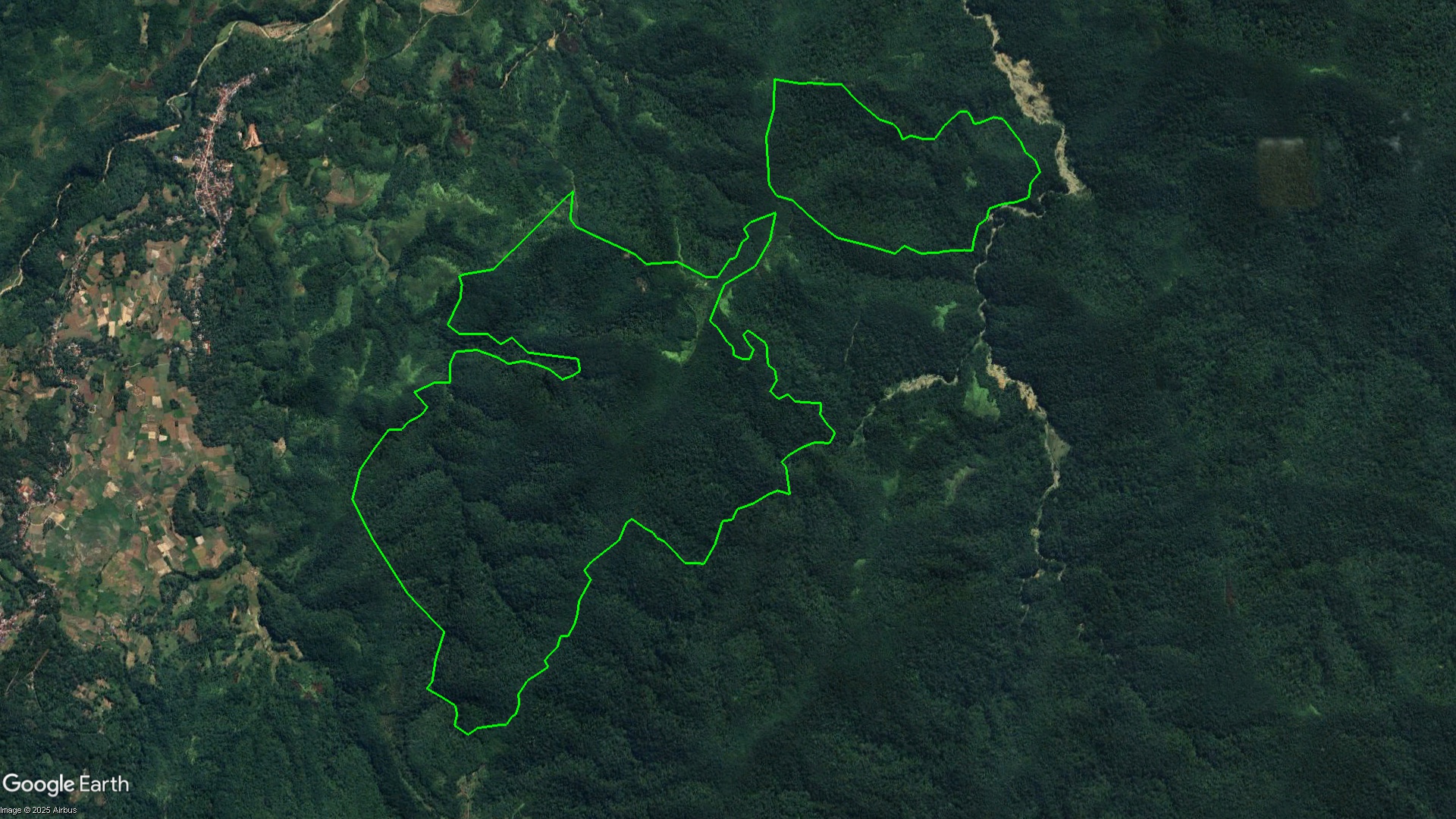
It is located in the west of Sumatra and covers 612,2 hectares. With the help of local communities, Kalaweit wishes to protect 300 additional hectares. About fifty hectares have already been staked out by our team and the villagers. It is a primary and secondary forest, with a high conservation value. It is located between 600 and 1050 meters above the sea and is a rather steep area which, for the time being, makes it difficult for human exploitation.
It borders our Supayang camp and is very rich in biodiversity. It harbours gibbons, siamangs, bears, clouded leopards, golden cats oa Asia, pangolins, tapirs, Sumatran dhole, muntjacs and tigers! It is a rare opportunity to be able to protect a forest of this quality. Today, it borders a forest of 20,000 hectares.
Island of Siberut
Mentawai Archipelago
Salaibaga
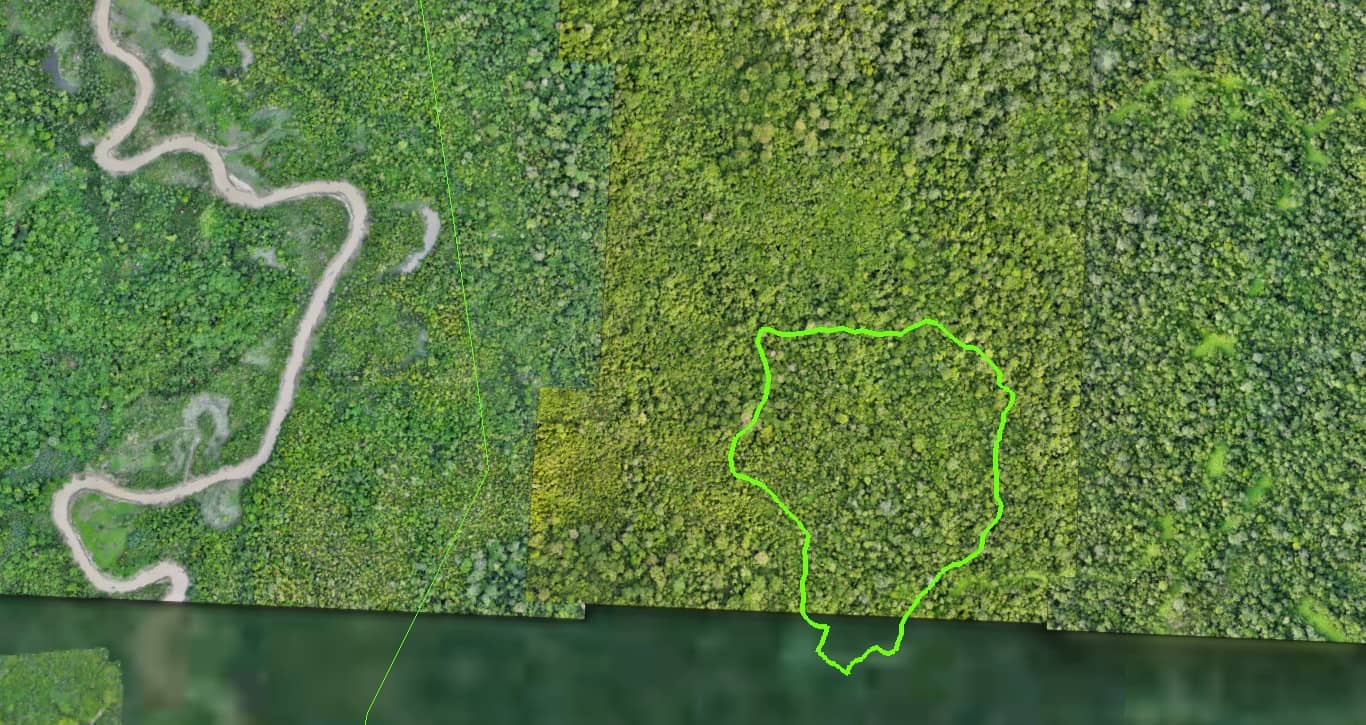
The Salaibaga forest is located on the island of Siberut, in the archipelago of the Mentawai Islands, 150 km off the west coast of Sumatra. This island is the largest of the archipelago and was recognized by UNESCO as a biosphere reserve in 1981. It is particularly known because of the presence of “flower-men“, an ethnic group with an animist and semi-nomadic hunter-gatherer lifestyle that can only be found on this island.
It is an extremely important island for biodiversity, all the animal species found there are endemic.
The Salaibaga forest is located northeast of the island of Siberut. It is home to 4 endemic primate species: the macaque of Mentawai, the semnopithecine of Mentawai, the gibbon of Kloss and the nasique of Mentawai. There are also many mammals such as the Mentawai civet, the Siberut flying squirrel and a variety of more than 70 species of birds like the Mentawai owl, the white-winged tern, or the white-bellied sea eagle.
In February 2026, after a year and a half of scouting and meetings with several villages wanting to protect their forests, Kalaweit signed a memorandum of understanding with three ethnic groups to protect an area of 3,000 hectares of forest within 2 to 3 years. It is in an area of the cadastre that can evolve and which will perhaps authorize, in the coming years, monocultures like that of oil palm. This could therefore encourage massive deforestation and we must impose ourselves as a partner with the villages with which we collaborate.
The urgency is less than in Borneo with the Grande Dulan; it is a fundamental effort to co-manage the forest with the three ethnic groups concerned, who still have access to this forest for their traditional activities. Then, a concession will be requested in Jakarta to manage this forest, in addition to helping to take into account the land rights of local populations at first.
A first transaction was carried out to secure 20 hectares of forest. Panels have been installed at the boundaries of the protected area, the surface of which will gradually expand.
Our
care centers
Kalaweit cares for sevaral animals rescued from wildlife trafficking.
Each treatment center is equipped with a veterinary clinic, a storage room for the animal’s food, buildings for our teams (kitchen, bedrooms, bathroom, guard post) as well as stalls our patrol horses.
These are closed to outside visitors.
In Borneo, our center is in the village of Pararawen, a day’s drive from the city of Palangkaraya. The one in Sumatra is in the village of Supayang, a three-hour drive from the city of Padang. Both are located on our own land, close to our reserves.
Hundreds of animals under our responsibility
Kalaweit no longer accepts new animals. However, more than 330 animals are still in our care centres. These are mainly gibbons and siamangs, as well as bears and crocodiles.
All come from the wildlife trade and are confiscated by the Forestry Department which entrusted them to us. In some cases, the owners handed them over to us directly.
The Kalaweit care centers are managed by Yayasan Kalaweit Indonesia, sister organisation of Kalaweit France.
Buying an animals to save it from trafficking is a mistake : it perpetuates wildlife trafficking.
For more than 20 years, the association has rescued thousands of wild animals caught up in trafficking (or in human/wildlife conflicts, in which case they were moved to a safe area). Weakened, stressed and traumatised, many had never seen another member of their species. They often suffered from malnutrition and required care.
After several weeks in quarantine to allow our veterinary team to assess their health and put in place an appropriate care protocol, they were transferred to the appropriate facilities.
For gibbons and siamangs, our priority was to find the right life partner for each of them as soon as they were released from quarantine.
For gibbons and siamangs, our priority was to find the right life partner for each of them, as soon as they were released from quarantine.
They are monogamous animals which do not tolerate solitude. Pairing the animals together is delicate with the risk of sometimes aggressive confrontation. Due to our experience, we get positive results most of the time. Unfortunately, some individuals have suffered too much psychologically, refusing all partners and must remain alone in their aviary.
In addition, the frantic pace of deforestation makes each release extremely complex. Gibbons, especially, need space. Each pair needs a territory of at least 12 hectares, much more (20, 30, 40 hectares, etc.) if the forest is degraded.
The vast majority of the gibbons ans siamangs collected will never leave Kalaweit.
They are unable to cope in the wild, disabled or infected with human diseases such as Herpes Simplex, or Hepatitis A or B.
The infrastructures
Gibbons are very territorial and are installed in large aviaries, all distant from each other.
The vegetation, consisting of large trees, is left intact between the aviaries to limit the stress caused by the visual contact between the pairs. These are double diamond-shaped aviaries, equipped (ropes, branches, etc.) and fitted with a removable partition in the middle to separate the partners if necessary.
Each is 12 meters long by 6 meters high and has an integrated quarantine area. In case of illness, this allows us to easily isolate one of the gibbons without taking him / her away from his / her partner which accelerates their healing. The pairs are very united, and any separation is a great stress factor for the animals. Youngsters (under the age of 7) are grouped together in socialization cages before they are paired off.
The crocodiles are placed in 5 pens, with large pools. The enclosures can be connected together or isolated. Electric fences have been installed at the interior limits of the enclosures of potentially dangerous animals (bears, crocodiles) to prevent them escaping.
The bears are grouped in several enclosures of 15 by 25 meters which are linked to each other. Each enclosure has a pool and furnishings (tires, rest platforms) and the enclosures may or may not be connected to each other.
The other animals (macaques, loris, birds, etc.) are systematically placed in enclosures adapted to their needs.
The installations run entirely on solar energy.
Each center is run by a manager…
who supervises a team composed of carers, veterinarians, guards, cooks and masons.
The animals are fed twice a day, which requires regular supplies of fruit, vegetables, etc. More than 5 tonnes of food are delivered to Kalaweit every week! In addition, there are vitamins and, of course, treatments for sick animals.
Teams of masons are constantly working on the repair of infrastructures.
We continually require funds to provide the best possible living conditions to all these victims of mankind’s actions. It is a great responsibility for Kalaweit with truly long-term commitment.